

The Armstrong School District Board of School Directors met on May 11, 2026 to address a projected $4 million budget shortfall and debate a potential tax increase. Outside the meeting room, residents were already making their position clear.
“No tax hike,” wrote one commenter on a local Facebook post urging residents to contact board members before the vote. “I’m on a fixed income,” wrote another. A third put it simply: “We pay enough damn taxes.”
Armstrong is not alone. School districts across the country are contending with a budget crunch as federal COVID-19 relief funds — known as ESSER — have dried up, leaving districts that expanded programs and staff during the pandemic now scrambling to cover costs on their own.
While fixed costs continue to rise, overall federal funding is projected to decrease by as much as 22 percent between the 2024–25 and 2025–26 school years, driven largely by a $24 billion loss for school districts nationwide stemming from ESSER’s expiration, according to a McKinsey analysis.
Article Summary:
The Armstrong School District is working through a significant budget shortfall of nearly $4 million, a challenge that has drawn widespread concern from the local community. This local standoff highlights the financial pressures currently facing many rural districts as they attempt to balance essential educational services with the economic realities of their residents.
The Looming Fiscal Gap:
A proposed 3.5% tax increase would generate roughly $1 million — covering just 25% of the district’s $4 million deficit.
Board President Ashley McIntyre says the hike “does not fix our financial outlook for the next year or the following year.”
Without significant changes, the district’s fund balance could be fully depleted by 2030.
Board members at the meeting were divided on what to do about it in their district.
Board President Ashley McIntyre noted the proposed tax increase would generate roughly $1 million — about 25% of the deficit. “A tax increase much like last year does not fix our financial outlook for the next year or the following year,” she said.
Board member Tiffany Swartz read a prepared statement into the record saying she could not support the increase. “The reality is we are still facing a deficit even after the increase,” she said. Swartz called for the district to examine administrative redundancies, expand its cyber program, and explore a four-day school week and before-and-after school programming as longer-term solutions. The four-day school week idea is gaining traction nationally — more than 2,100 schools across 26 states have adopted shortened weeks, largely as a cost-saving measure.
Director Todd Luke argued that maintaining programs and facilities requires funding. “If we want to attract the best teachers to our district, educate children of the future, we have to pay the bill,” he said. He warned that without action, the fund balance could be depleted by 2030.
The skepticism in the Facebook comments tracked closely with concerns raised inside the meeting room. Residents on fixed incomes pushed back hard against any increase, a sentiment echoing across communities nationwide as inflation continues to squeeze household budgets. One resident online asked why a county “that has nothing is paying the highest wages for their district and some of the lowest test scores.”
Administrative spending has become a flashpoint in budget fights at districts around the country, as taxpayers and board members alike question whether existing staff can absorb more responsibility before new positions are filled. Armstrong is no exception.
On one popular Facebook thread, a resident asked why the district was looking to add administrators despite declining enrollment. Board member Jorn Jensen, who said his phone had been ringing all day with constituent calls, weighed in.
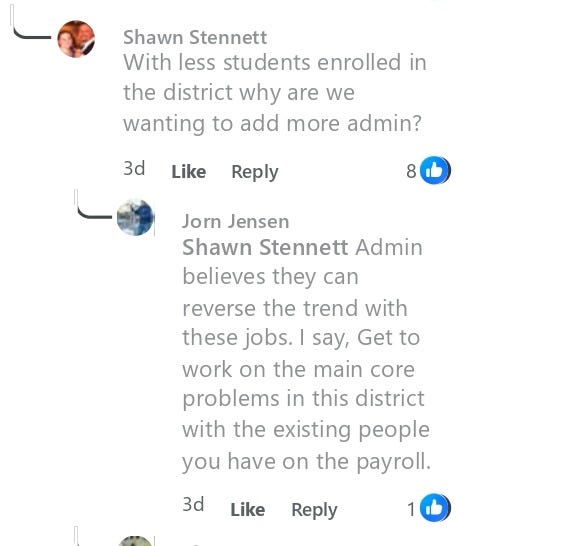
“Admin believes they can reverse the trend with these jobs,” he wrote. “I say, get to work on the main core problems in this district with the existing people you have on the payroll.”
Marguerite Roza, director of Georgetown University’s Edunomics Lab, told K-12 Dive that when cuts do come, support staff like counselors, social workers, and reading coaches are often among the first to go.
The board did not take a final vote on the tax increase. By the end of the meeting, McIntyre summarized the tentative consensus: there is some willingness to consider a tax increase, but only if administration returns with a serious plan to cut costs first.
“There’s a stomach for increased taxes so long as we go back to the drawing board,” she said.
You can watch the full meeting recording on the Armstrong School District website here.
Editor's note: A reader noted that individual board member positions on the tax increase were not included in this article. The consensus check was conducted twice due to the complexity of the discussion, with several members adding nuance to their positions mid-vote. For a full picture of where each member stands, I encourage readers to watch the meeting recording linked above.
I WANT TO HEAR FROM YOU —
Armstrong County is at the center of some big conversations right now. Share your thoughts on:
The Armstrong School District tax debate
The Cadogan mine site and its regulatory history
Proposed housing development on Cadogan land
Data mining centers coming to the region
Drop a comment, email me at cereeseblose@gmail.com or message me directly here or on Signal: cereeseblose.57
Cereese Receipts is an independent publication. I believe understanding economy, business and tech should be accessible to everyone.
If you enjoy my writing, you can support it by sharing, commenting, or liking—or by sending a small donation through Buy Me a Coffee. It’s an easy way to say thanks and support independent writing.